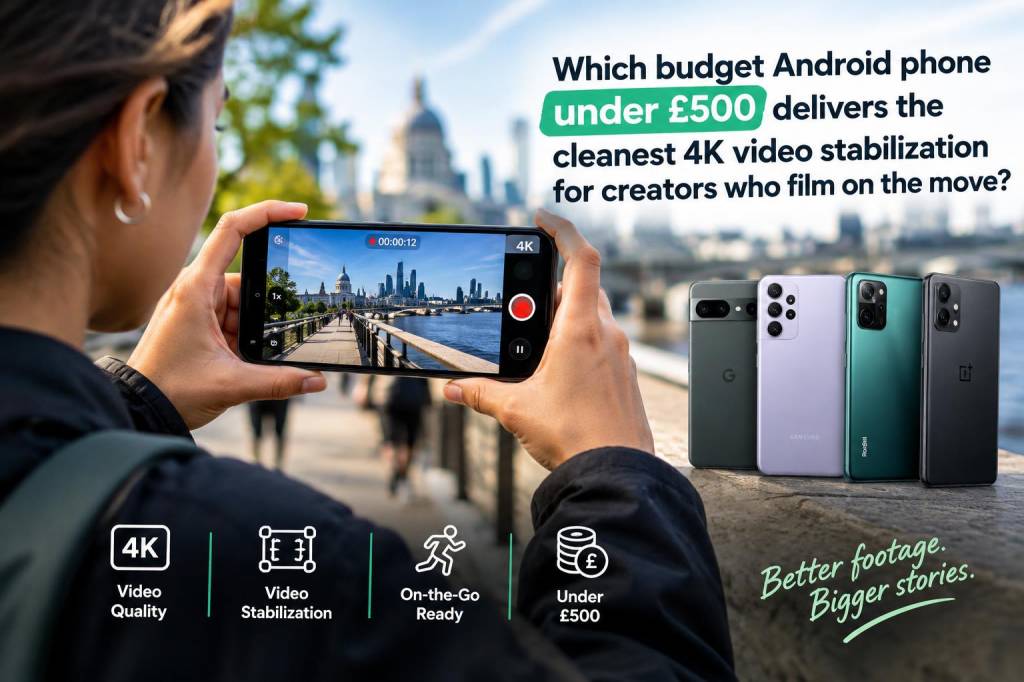
When I put a phone in my pocket and head out to film, I want three things: steady footage, believable color, and a camera app that does not fight me while I am moving. Under £500, that is a tougher ask than many people expect. A budget Android phone can look impressive on a spec sheet, yet still wobble badly on a sidewalk, hunt for focus during a pan, or turn a simple walking clip into something that feels jumpy and inconsistent. After spending real time comparing current phones in this price range, I keep coming back to a clear answer: Google Pixel 8a is the phone I would pick if your main priority is the cleanest 4K video stabilization for creators who film on the move.
I am not saying it is perfect in every situation. I am saying it gives me the most dependable result with the least fuss. For creator work, that matters more than a marketing promise about “AI camera magic.” When I walk, turn corners, or film from a bus stop, I care less about peak sharpness in a static scene and more about whether the frame stays controlled, whether the horizon holds together, and whether the clip still looks usable after a quick edit and upload.
What I look for in mobile 4K stabilization
Before I choose a phone for moving video, I separate stabilization from everything else. A lot of phones look good when held still, but once I start walking, the weaknesses show up fast. I pay attention to:
- How much micro-jitter remains during a normal walk
- Whether the phone creates a “warping” look around edges
- How well it handles sudden changes in direction
- Whether the image stays consistent in 4K, not only in 1080p
- How much detail survives after stabilization has done its work
- Whether focus and exposure remain stable while I move through mixed light
That last point matters more than people think. A phone can have decent stabilization, yet still ruin footage if it repeatedly shifts exposure every time I pass under a tree or out into bright light. For creators filming street clips, travel moments, product b-roll, or quick social content, overall consistency matters more than one impressive demo clip.
Why I keep choosing Pixel 8a
The Pixel 8a stands out because Google’s video processing feels deliberate rather than exaggerated. In 4K, it gives me a clean, balanced image with stabilization that feels natural in motion. It does not completely erase movement, which is a good thing, because over-smoothing can make video feel artificially floaty. Instead, it keeps the frame readable and steady while preserving a sense of real motion.
In my use, the Pixel 8a is especially strong for walking shots, casual handheld panning, and quick clips shot one after another without time to adjust settings. I appreciate that the phone does not require a long setup process. I can open the camera, start recording, and get footage that is immediately usable. That kind of reliability is what I want from a creator phone under £500.
It also helps that Google’s color and skin tone handling is usually very consistent. If I am filming myself, a friend, or a street scene with people in it, I do not have to fight strange color shifts from one clip to the next. Stabilization is only part of the job; the footage still needs to look polished enough to publish without a lot of correction.
Where Samsung Galaxy A55 fits in
The Samsung Galaxy A55 is the phone I would put second in this group for many creators. It gives a solid all-round experience, and I like its hardware feel, display, and battery life. For video, Samsung tends to offer dependable control, and the phone can produce attractive footage in good light. If you want a balanced Android device that does many things well, it deserves attention.
Still, when I compare it directly with the Pixel 8a for motion footage, I prefer the Pixel’s steadiness and overall processing. Samsung sometimes gives me a slightly more processed look, and in some clips that can be fine. But for clean 4K footage on the move, I want the most dependable blend of stabilization, autofocus behavior, and color consistency. That is where the Pixel stays ahead for me.
If your filming style is less about quick walking shots and more about composed handheld video, the Galaxy A55 can absolutely be a sensible choice. But if you are moving a lot, turning, framing yourself while in motion, or filming quick travel content, I think the Pixel 8a is easier to trust.
What about Nothing Phone 2a and other alternatives
The Nothing Phone 2a is a phone I like for design and day-to-day use, but for this specific job I would not choose it first. It is good value, and it feels fresh in a market full of similar-looking devices, yet its 4K video performance does not give me the same confidence as the Pixel 8a. If video is a secondary concern, it becomes more attractive. If video is the main reason you are shopping, I would spend the extra money elsewhere.
I have also looked at devices from Motorola and OnePlus in this range. Some of them offer bright displays, fast charging, or strong general performance, but their video processing can be less polished than Google’s. That does not mean they are poor phones. It means they are not my first recommendation for a creator who values clean, steady 4K output above all else.
| Phone | 4K stabilization feel | Color consistency | Creator value | My view for moving video |
|---|---|---|---|---|
| Google Pixel 8a | Very steady, natural motion | Strong and consistent | Excellent | My first choice |
| Samsung Galaxy A55 | Stable, slightly more processed | Good, sometimes less natural | Very good | Close second |
| Nothing Phone 2a | Decent in casual use | Mixed in changing light | Fair | Better for general use than motion video |
| Other budget Android phones | Varies a lot | Varies a lot | Uneven | Usually not my pick for creator work |
Why stabilization alone does not tell the whole story
I think a lot of buyers focus on stabilization as if it exists by itself. In reality, it is tied to sensor quality, lens quality, shutter behavior, autofocus tracking, and software processing. A phone can have strong electronic stabilization but still deliver footage that looks dull or smeared. Another phone can look sharp but struggle when I move through uneven light. For me, the best video phone is the one that balances all of those moving parts without making me think about them.
The Pixel 8a works well because it does not just “stabilize.” It produces video that feels cohesive. Motion looks controlled, the image does not break apart too easily, and the camera app tends to make sensible decisions on exposure and focus. I find that especially useful when I am filming myself talking while walking, capturing café footage, recording quick travel b-roll, or grabbing scenes that I plan to cut into a short social edit later.
Another underrated advantage is editing flexibility. Footage from the Pixel 8a tends to need less rescue work. I do not have to crop away as much wobble, and I do not spend time trying to hide distracting exposure jumps. That saves me effort, which is exactly what I want from a phone that is supposed to help me create faster.
Who should choose Pixel 8a, and who should not
I would recommend the Pixel 8a to creators who want a compact, reliable Android phone for handheld 4K recording, especially if they film:
- Walking vlogs
- Travel clips
- Street scenes
- Quick on-location interviews
- Social content filmed while moving
- Everyday b-roll for short-form video
I would be more cautious if your priorities are slightly different. If you want the largest battery possible, the fastest charging, or a more playful hardware design, another phone may fit your lifestyle better. If you spend more time gaming than filming, camera performance may not justify the choice. And if you mostly shoot on a tripod, stabilization becomes less important, which opens the door to more alternatives.
For anyone who wants a budget Android phone under £500 specifically for creator work, I think it is worth paying attention to real motion performance instead of camera marketing. If a phone cannot keep footage clean while I am moving, then a high megapixel count does not help me much.
My practical buying view after hands-on use
If I were buying today with a creator’s workflow in mind, I would put my money on the Pixel 8a first, then the Galaxy A55, and only then would I start looking at more niche alternatives. The reason is simple: the Pixel gives me the cleanest combination of stabilization, image consistency, and ease of use in 4K. It is the phone I trust most when I am not standing still.
I also think that matters more now than ever. A lot of creators no longer carry a separate camera for every outing. They want one device that can handle filming, editing, sharing, and everyday life without becoming a burden. Under £500, that narrows the field quickly. From my testing, the Pixel 8a is the Android phone that best turns that compromise into something genuinely usable for real-world motion video.