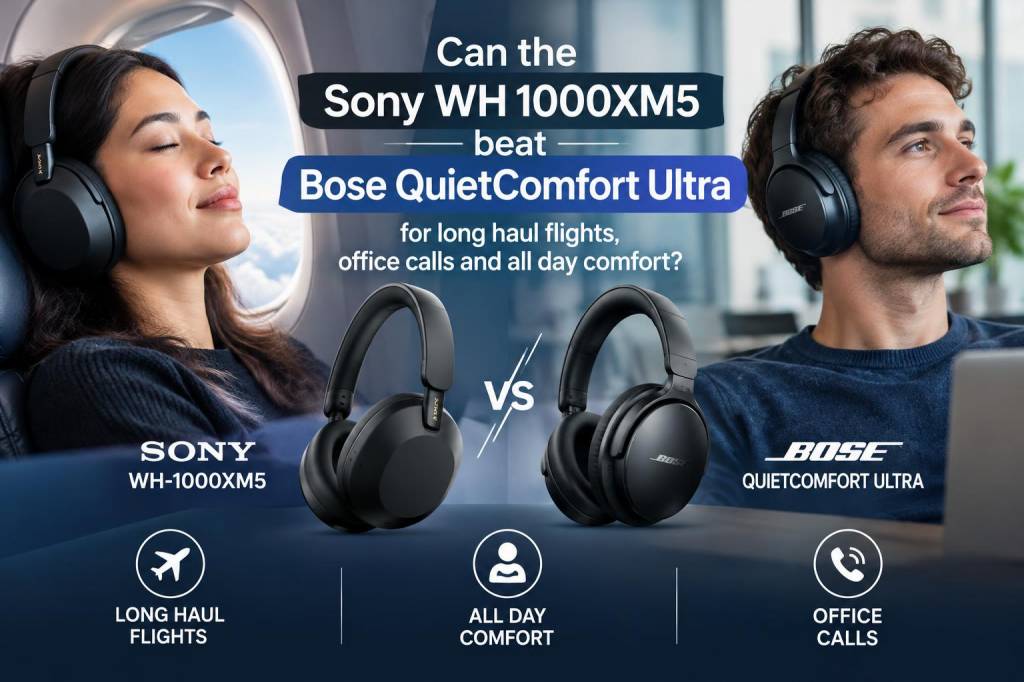
I have spent enough hours on planes, in open offices, and at kitchen tables turned into temporary workstations to know that a headphone can feel perfect in one setting and disappointing in another. That is exactly why I keep coming back to a comparison between the Sony WH-1000XM5 and the Bose QuietComfort Ultra. Both are premium noise-cancelling headphones, both are aimed at people who travel, work, and listen all day, and both promise comfort that lasts far beyond a short commute. In real life, though, I find that their strengths show up in slightly different ways depending on whether I am trying to sleep through engine noise, take a video call without sounding muffled, or keep them on for a full workday without fidgeting.
My honest answer is that neither pair is a universal winner. If I am packing for a long-haul flight and want a calm, easy listening experience with a slightly more relaxed fit, Bose has a very strong case. If I want a richer feature set, stronger app control, and a more versatile package for mixed daily use, Sony often pulls ahead. What makes this comparison interesting is that both are excellent enough that small differences start to matter: clamp pressure, microphone behavior, noise cancellation character, and even how each pair behaves after several uninterrupted hours.
Comfort during long flights
For long-haul flights, comfort is not just about soft ear cushions. It is also about headband pressure, heat buildup, weight distribution, and whether the headphones remain pleasant after you have worn them for six or eight hours straight. When I use the Bose QuietComfort Ultra, the first thing I notice is how easy they feel to live with. The fit feels forgiving, and the clamping force is gentle enough that I do not get the same sense of fatigue I sometimes feel with tighter designs. For people with sensitive heads or glasses, that softness can matter a lot after the third hour in a seat.
The Sony WH-1000XM5 also feels light, and Sony has done a very good job with materials and padding. In short sessions, I would happily call them comfortable. Over a longer flight, though, I notice that Bose gives me a slightly more relaxed experience. Sony’s fit feels a little more structured, which I appreciate when I am moving around, but Bose edges ahead when I am sitting still for a very long time. That said, head shape makes a bigger difference than spec sheets suggest, so I would never call this a universal result.
Noise cancellation is the other half of flight comfort, because a quieter cabin makes everything easier: listening at lower volume, sleeping more easily, and reducing listening fatigue. Sony and Bose both do an excellent job, but they do it with slightly different personalities. Sony tends to create a very strong sense of isolation, especially against low-frequency engine rumble. Bose remains superb as well, and I often find it a little more natural and less distracting in how it handles shifting cabin noise. If I were choosing solely for aircraft use, I would say Bose feels more effortless, while Sony feels more aggressive in suppressing sound.
Office calls and microphone performance
Office calls are where a lot of premium headphones quietly disappoint. A great listening experience does not automatically mean a great microphone experience. In meetings, I care about whether my voice stays clear when I am speaking in a noisy room, whether keyboard noise leaks through, and whether the headphones preserve a natural tone instead of making me sound compressed or distant.
In my experience, both models are capable, but Sony WH-1000XM5 has a slight edge when the environment is tricky. The microphone system does a strong job of focusing on speech and reducing random background noise. If I am working from a café, a busy house, or a shared office, Sony often makes me sound more intelligible to the person on the other end. The voice pickup is not flawless, and it can still sound processed, but it is consistently usable in more situations than many competing headphones.
Bose QuietComfort Ultra is also very good, and for calm environments it can sound excellent. Where I notice differences is in harsher conditions. If there is a lot of ambient noise or intermittent sound around me, Bose sometimes feels a touch less assertive at separating my voice from the room. For straightforward office calls, though, I would still be comfortable using either pair. I would simply choose Sony more often if I expected to take several back-to-back calls in imperfect environments.
One thing I value is how quickly a headset becomes invisible during a meeting. Sony does that well because the app and controls feel polished, and because the microphone system is dependable. Bose does it well because the comfort level is so high that I can forget I am wearing anything at all. If my day is mostly meetings, I care about both. If the room is noisy, Sony feels like the safer bet. If the room is quiet, Bose is absolutely competitive.
Sound character for work and travel
Sound quality is subjective, but my personal impression is that Sony and Bose are tuned for slightly different moods. The WH-1000XM5 leans toward a more lively, polished sound with a sense of energy that suits modern pop, podcasts, and long sessions of mixed listening. It is detailed without becoming exhausting, and I enjoy how easy it is to adjust the EQ in the Sony app when I want more bass, a cleaner midrange, or a slightly brighter presentation.
The QuietComfort Ultra feels more restrained and smooth in a way that some people will love instantly. Bose tends to make listening feel calm rather than flashy. That matters on flights, where I often want something that sounds pleasant at lower volume and does not demand my full attention. If I am watching films on a plane or catching up on podcasts, Bose gives me a very easy listen. If I am switching between music, calls, and focus sessions at my desk, Sony’s tuning and app flexibility often suit me better.
I would not call either one neutral in a strict studio sense. These are consumer headphones meant to make everyday life easier, and they both do that well. Sony feels more customizable. Bose feels more immediately effortless. That difference is small at first, but over weeks of use, it becomes meaningful.
Battery life, charging, and travel practicality
Battery life is one of those things I stop noticing only when it is excellent. Both headphones are strong here, and both can handle a full day of work plus additional listening without drama. In practical terms, that means I do not think about charging constantly, which is exactly what I want from premium wireless headphones. For travel, that matters because I want to board a plane with confidence, use them across connections, and not hunt for a charger in the middle of a layover.
Sony has long been impressive on battery performance, and the WH-1000XM5 continues that pattern. Bose QuietComfort Ultra is also solid enough for real travel use. In daily life, I would not choose between them solely on battery, because both are good enough that other factors become more important. What I do pay attention to is convenience: fast charging, app visibility into battery status, and whether the headphones behave predictably when I am moving between devices. Sony generally feels slightly more feature-rich here, while Bose keeps things straightforward.
Travel practicality also includes folding and storage. This is one area where preferences get personal fast. If you care about compact packing and a very tidy case experience, you may have strong feelings about how each brand handles portability. I tend to judge them by how painless they are to throw into a backpack, and both do that job well enough for me to travel confidently.
What I notice after several hours
After several hours, small annoyances become obvious. Does the headband start pressing in one spot? Do my ears warm up too much? Do I want to take them off during a break just to feel less enclosed? That is where the Bose QuietComfort Ultra often wins my personal comfort vote. It is not that Sony becomes uncomfortable; it is that Bose seems to disappear a little more easily during prolonged use.
At the same time, I appreciate that Sony WH-1000XM5 gives me a stronger sense of control over the whole experience. I can fine-tune the sound, adjust noise-cancelling behavior through the app ecosystem, and use features that make the headphones feel like a more complete productivity tool. For someone who wants one pair for travel, calls, and daily listening, that flexibility is a real advantage. I often find myself reaching for Sony when I want to do more than just sit quietly and listen.
| Category | Sony WH-1000XM5 | Bose QuietComfort Ultra |
|---|---|---|
| Long-flight comfort | Very good, slightly more structured | Excellent, slightly more relaxed |
| Noise cancellation | Very strong, especially for engine rumble | Excellent, very natural feeling |
| Office calls | Strong in noisy environments | Very good in quieter spaces |
| Sound tuning | More customizable and energetic | Smoother and more effortless |
| All-day use | Highly capable and versatile | Exceptionally easy to wear |
Who I would choose for each situation
If I were boarding a long-haul flight and wanted maximum comfort with a calm, low-stress fit, I would lean toward Bose QuietComfort Ultra. If I knew I would be taking office calls in varied or noisy environments, I would lean toward Sony WH-1000XM5. If I wanted one pair for travel, work, entertainment, and daily use, Sony feels like the more versatile package overall. If my priority were simply to wear headphones for hour after hour with as little physical awareness as possible, Bose has a very persuasive argument.
What makes this comparison worth caring about is that both products solve a real problem very well. I never feel like I am comparing a good headphone to a weak one. I feel like I am comparing two different philosophies. Sony gives me more control, more features, and a slightly more powerful all-round toolkit. Bose gives me a softer, more effortless comfort experience that can be especially appealing on long flights or when I want to forget I am wearing headphones at all. If I had to live with one pair for a year of airports, meetings, and long listening sessions, I would choose based on which of those experiences I value more on an average week.
What I keep coming back to, after repeated use, is that both headphones earn their premium status in different ways. Sony impresses me by being consistently capable across tasks. Bose impresses me by making long wear feel so natural that I stop thinking about the hardware and focus on what I am doing. For anyone deciding between them, that distinction is probably more important than any single specification.