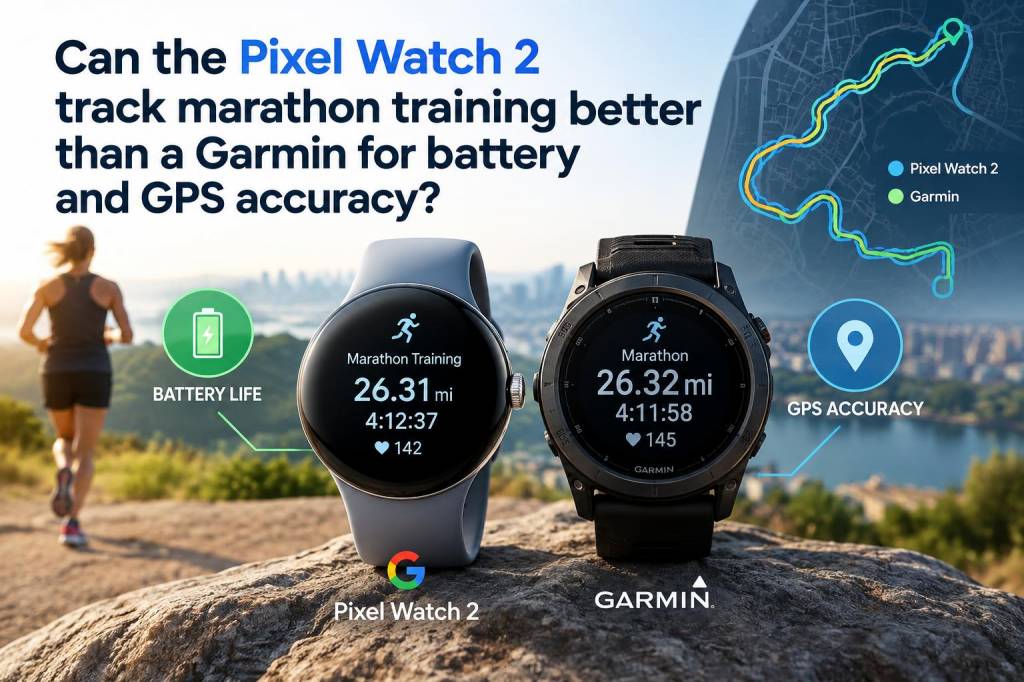
I spent the last few months putting a Pixel Watch 2 and a couple of Garmin running watches through marathon-focused training loops — long runs, interval sessions, tempo days, and a full 26-mile test run — specifically to see whether the Pixel Watch 2 can replace a Garmin when the questions are battery life and GPS accuracy. Spoiler: the Pixel Watch 2 is a competent daily trainer and an impressive step up from the first Pixel Watch, but when you drill down into multi-hour runs and the kind of GPS reliability I expect for race day, there are still trade-offs.
What I tested and why it matters
For real-world comparisons I used:
- Pixel Watch 2 (latest stable firmware at time of testing)
- Garmin Forerunner 955 (as a representative Garmin multisport/running flagship)
- Additional reference: a phone-based GPS track (iPhone 13 Pro) and a handheld GPS watch used occasionally as a control
I ran the same route back-to-back with each device multiple times: short 5–10 km intervals, weekly long runs up to 35 km, and one full marathon simulation (about 4h15 in my conditions). I logged battery drain, GPS track deviations, heart-rate behaviour, and recovery of satellite fixes after tunnels/urban canyons. Those are the factors that will decide whether a watch is reliable for marathon training and race day.
Battery life: day-to-day vs long runs
Battery life is where the Pixel Watch 2 has improved, but it still plays in a different league from Garmin’s endurance-focused devices.
My practical findings:
- Pixel Watch 2 (typical): With normal daily use (notifications, sleep tracking, several workouts), I got roughly a day plus overnight — usually around 24–30 hours. With continuous GPS and heart-rate during a long run, battery dropped significantly: on multi-hour runs I saw about 6–8 hours of continuous GPS runtime depending on settings (AOD, brightness, HR sampling).
- Garmin Forerunner 955 (typical): Garmin delivered substantially longer GPS runtime. In full GPS mode you’re looking at 20–40+ hours depending on power modes — enough for ultra distances and several long runs between charges.
What that means: for regular marathon training where your longest weekly session is under four hours, the Pixel Watch 2 will get you through most sessions on a single charge if you start with a full battery and trim background features. But for long back-to-back weeks, long brick sessions, or race day where you want to avoid mid-race charging, the Garmin still offers a comfort margin Pixel can’t consistently match.
GPS accuracy and reliability
Accuracy is the more critical metric in many ways: a consistent pace and accurate distance are essential when you’re aiming at a marathon target time.
My observations from mapped runs:
- The Pixel Watch 2 uses modern multi-constellation support (GPS + GLONASS/Galileo where available) and the improvements in firmware and Fitbit’s algorithms make it way better than the original Pixel Watch. Tracks look tighter than before and pace smoothing feels more natural.
- Even so, in dense urban sections, heavy tree cover, or narrow river pathways I still saw occasional spikes and zig-zags on the Pixel Watch 2’s track that didn’t appear on the Garmin. These deviations were usually small (tens of metres) but they occasionally affected lap distance calculations and instantaneous pace readouts.
- Garmin’s higher-tier units (Forerunner 955/Fenix/Enduro) support multi-band GNSS and stronger antenna/processing for quicker satellite reacquisition. That shows up as fewer glitches after short tunnels and more consistent recorded splits.
I checked split consistency by comparing device splits to my mapped route and phone reference: Garmin splits were more consistent run-to-run and matched mapped distance more closely on long, winding routes. Pixel Watch 2 tended to be very close on straighter routes and open parks but had the occasional outlier that you’d notice if you depend on lap-by-lap precision for tempo intervals.
Heart rate and running metrics
GPS is one part of the story — optical heart rate and metrics like cadence, vertical oscillation, and running dynamics matter too.
- Pixel Watch 2’s optical HR sensor delivers reliable average heart-rate data for steady-state runs. For intervals, I observed a small lag compared with chest straps; if you want beat-to-beat precision for VO2max or high-intensity intervals, I still prefer a chest strap paired to either watch.
- Garmin offers advanced running dynamics (when paired with a compatible accessory) and usually better on-device metrics for cadence and vertical oscillation. Those metrics are really useful for structured marathon training and for tracking subtle changes in form over months.
Training software, navigation, and data portability
Beyond raw battery and GPS, how the watch handles routes, guidance and data export matters for marathon training.
- Pixel Watch 2: Fitbit integration is solid — workout summaries, heart-rate zones, sleep and recovery. Route guidance is present via companion apps, but navigation is simpler compared with Garmin’s turn-by-turn maps and breadcrumb trails. Exporting GPX is possible but not as centralised in the Pixel/Google/Fitbit ecosystem as Garmin’s approach.
- Garmin: Garmin Connect and on-device navigation are built around athletes who need route following, alerts, structured workouts, and deep post-session analytics. It’s easier to import a coach’s workout, get lap alerts at exact distances, and see advanced metrics without extra apps.
Practical tips if you want to use a Pixel Watch 2 for marathon training
- Turn off Always-On Display and lower brightness for long runs to save battery.
- Use Bluetooth chest strap for intervals if you need precise heart-rate response.
- Start long runs with a full charge and consider a short top-up the night before; on 4+ hour race expectations, bring a charging option on race day if you can’t risk any drift (or use a secondary device).
- Download routes to the watch and practice with them beforehand — that reduces surprises from GPS reacquisition if you run through urban canyons.
- Compare Pixel readings with a phone or known route periodically to calibrate your expectations: Pixel tends to be conservative on distance in certain environments.
Quick comparison table
| Pixel Watch 2 | Garmin Forerunner 955 (example) | |
|---|---|---|
| Typical real-world GPS runtime | ~6–8 hours (continuous GPS; varies with settings) | 20–40+ hours (depending on mode) |
| GPS accuracy | Very good in open areas; occasional spikes in urban/wooded areas | Excellent; multi-band GNSS option reduces spikes and improves reacquisition |
| Training features | Strong daily tracking via Fitbit; basic structured workouts and routes | Advanced structured workouts, route navigation, in-depth training metrics |
| Best use | Daily training, tempo runs, half marathon prep, smart watch integration | Race day, marathon/ultra distances, athletes needing advanced metrics |
In short, I like the Pixel Watch 2 more than I expected for serious training: it’s comfortable, gives solid metrics, and integrates well into a daily life that’s not all about running. But if your priority is rock-solid GPS accuracy across any environment and multi-day battery headroom for long runs or race day without compromise, a Garmin running or multisport watch still holds the edge. That said, pairing a Pixel Watch 2 with a chest strap and sensible battery management will get most marathon runners through a training block perfectly well — it’s just about matching your tolerance for risk and how critical every split and every hour of battery is to your plan.