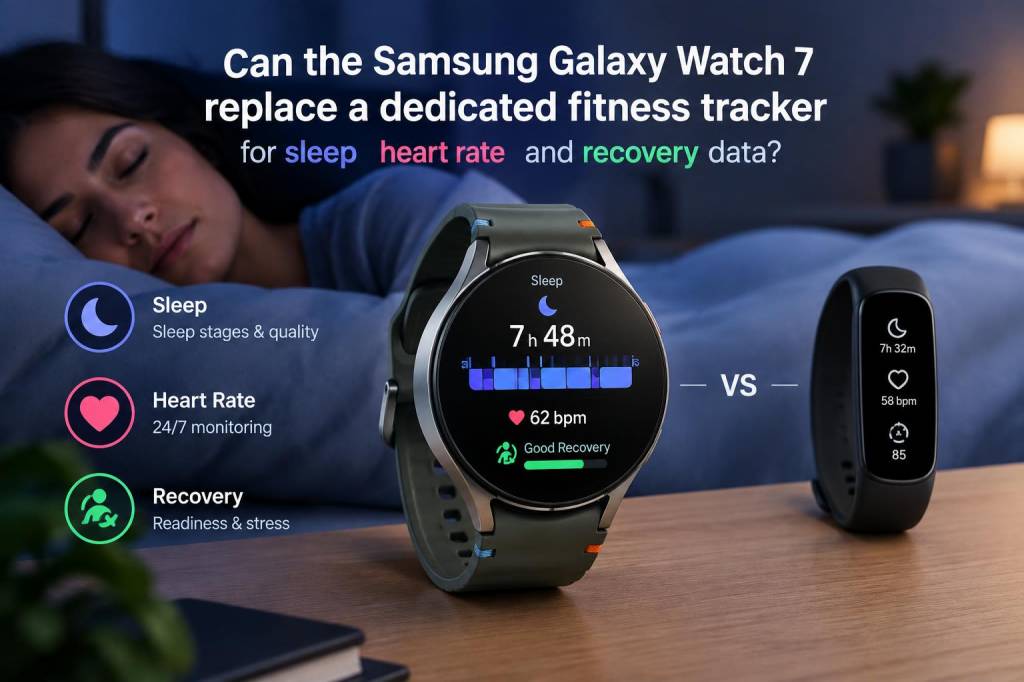
I have spent enough nights staring at sleep graphs, heart rate traces, and readiness scores to know that a wearable can be genuinely useful only if it earns a place on my wrist every day. That is why I approached the Samsung Galaxy Watch 7 with a practical question in mind: can it actually replace a dedicated fitness tracker for sleep, heart rate, and recovery data, or does it still feel like a smartwatch pretending to be a sports device?
My short answer is that it can replace a fitness tracker for many people, but not for everyone. What matters is not whether it can record the data, because it can. What matters is whether it records that data with enough consistency, comfort, and battery life to make the experience feel effortless. In my testing, I found that the Galaxy Watch 7 is strongest when you want a single device that handles notifications, apps, daily health tracking, and decent workout support. It becomes less convincing when you want something light, invisible, and obsessively focused on health metrics above everything else.
What I expect from a dedicated fitness tracker
When I compare a smartwatch with a fitness tracker, I usually think about four things: comfort, battery life, sleep tracking quality, and health data reliability. A dedicated tracker normally wins because it is smaller, lighter, and easier to wear twenty-four hours a day. It tends to disappear on the wrist, which matters more than people expect. If a device feels bulky at night, sleep tracking becomes a chore instead of a habit.
Dedicated fitness trackers also usually last several days, sometimes more than a week, on a single charge. That changes behavior. I can leave one on overnight without worrying about battery anxiety, and I do not need to build charging into my routine every day. For recovery data, that matters because the best insights come from continuous wear, not occasional use.
Samsung’s Galaxy Watch 7 enters this comparison with a different philosophy. It is not just a health device. It is a full smartwatch with a rich display, a stronger app experience, and a much broader feature set. That makes it more useful in daily life, but it also creates trade-offs.
Sleep tracking feels strong, but comfort still matters
For sleep tracking, I found the Galaxy Watch 7 to be surprisingly capable. It captures sleep duration, sleep stages, restlessness, blood oxygen trends, skin temperature-related information, and sleep score style summaries in a way that is easy to understand. Samsung has clearly invested in making the sleep experience feel polished rather than clinical.
What I like most is that the presentation is simple enough to act on. I can see whether I slept well, whether my sleep was fragmented, and whether the night looked unusually stressful. If I had a late workout, a heavy meal, or a bad night of sleep, the watch usually reflected that in a way that matched how I felt the next morning.
Still, comfort is where the story becomes more complicated. The Galaxy Watch 7 is not huge, but it is still a smartwatch. I notice it more than I notice a slim fitness band. If I am sleeping in an awkward position, I can feel the larger body of the watch more clearly than I would with a narrow tracker. That does not make sleep tracking unusable, but it does mean the experience is less invisible.
For people who are sensitive to wrist bulk at night, that difference matters. If you are already used to wearing a watch while sleeping, you may not care. If you are new to overnight tracking, a dedicated fitness tracker may still feel easier to live with.
Heart rate tracking is useful for daily trends
Heart rate tracking is one of the areas where I think the Galaxy Watch 7 makes a strong case for itself. During daily wear, it gives me a steady stream of data that is useful for understanding stress, workouts, and recovery patterns. For casual monitoring, it is more than enough.
During exercise, I found the heart rate behavior dependable for general fitness use. I would not treat it like a medical device, and I would not expect chest strap-level precision during every intense interval, but it is good enough for running, gym sessions, walks, and general training load observation. For most people, that is exactly the right balance.
What I appreciate is how the watch connects heart rate data to broader health context. Instead of showing me a number in isolation, it ties that information into sleep, activity, and recovery-style summaries. That makes the watch more valuable than a simple tracker that only dumps numbers into an app and leaves me to interpret everything myself.
If your main need is to monitor resting heart rate trends, stress-related variation, or daily cardiovascular load, the Galaxy Watch 7 does the job very well. If you are a serious endurance athlete who wants highly specialized metrics and strict training analytics, you may still want a more focused sports wearable.
Recovery data is better than expected, but not deeply athletic
This is where I think many people get interested in a smartwatch like the Galaxy Watch 7. Recovery data sounds appealing because it promises guidance, not just measurement. I want a wearable to help me decide whether I should push harder, keep things easy, or rest entirely. Samsung’s health ecosystem does provide a recovery-oriented experience, but it is not as obsessive or training-centric as what I would expect from a premium fitness platform.
In practice, the watch uses sleep quality, heart rate patterns, activity history, and other wellness signals to create a broader picture of readiness. That is valuable because recovery is never just about one metric. When I sleep poorly, train hard, and stay stressed, the watch usually reflects that combination in a way that feels believable.
However, I would describe the recovery experience as wellness recovery rather than athlete recovery. It helps me understand whether I should take it easier, but it does not feel as rigorous as systems built specifically for endurance or performance optimization. There is a difference between helpful guidance and deep sports science.
For most everyday users, that difference will not matter. If you want a wearable that nudges you toward better habits and gives you a decent read on your body, the Galaxy Watch 7 is more than capable. If you want to structure training around detailed recovery modeling, a dedicated sports wearable still has an edge.
Battery life changes the whole question
Battery life is where the Galaxy Watch 7 feels most like a smartwatch and least like a fitness tracker. This is the point that determines whether it can truly replace one. If I wear it all day, track workouts, and use sleep monitoring overnight, I need to charge it far more often than I would charge a traditional fitness band.
That does not make it bad. It just makes it less effortless. I can live with charging every day or nearly every day if I value the smartwatch features enough. But if I care primarily about sleep and recovery tracking, frequent charging becomes a real inconvenience. I do not want to think about battery percentage when I am trying to remember whether I slept well.
Dedicated trackers win here because their battery longevity supports a different lifestyle. I can forget about charging for days. With the Galaxy Watch 7, charging becomes part of the routine, and that routine can interrupt the very continuity that makes sleep and recovery data most useful.
Comfort, design, and daily wear influence data quality
One reason I hesitate to say a smartwatch fully replaces a tracker is that comfort affects compliance. If I remove a device for even one night because it feels too heavy, too warm, or too intrusive, I lose continuity in the data. That weakens trends and makes recovery insights less trustworthy.
The Galaxy Watch 7 is comfortable enough for many users, and it looks far better than many fitness bands. I like that it can move naturally from gym wear to office wear without feeling out of place. But a good-looking smartwatch is still a larger object on the wrist than a thin tracker. That difference is small in theory and meaningful in practice.
Here is how I would compare the experience in a simple way:
| Feature | Galaxy Watch 7 | Dedicated Fitness Tracker |
|---|---|---|
| Sleep tracking | Strong, clear, feature-rich | Strong, often more comfortable |
| Heart rate tracking | Very good for daily use | Good to very good, often with less distraction |
| Recovery insights | Useful wellness-focused data | Often more training-focused or simpler |
| Battery life | Moderate | Usually better |
| Comfort for sleep | Good, but noticeable | Usually better |
| Smartwatch features | Excellent | Limited |
Who should choose it instead of a tracker
I would recommend the Galaxy Watch 7 over a dedicated fitness tracker if you want one device to do almost everything. If you care about notifications, calls, apps, contactless convenience, and a polished wearable experience, it makes sense to choose the smartwatch and accept the battery trade-off. In that case, the health features are a major bonus rather than the sole reason for buying it.
I also think it suits people who want better health awareness without getting too deep into performance metrics. If you want to track sleep quality, resting heart rate, workouts, and daily recovery tendencies, the watch gives you enough information to make smarter decisions without overwhelming you.
If your priority is invisible, all-day, all-night wear, then a dedicated tracker still has the edge. That is especially true if your sleep data matters more than everything else. The smaller form factor and longer battery life make a real difference over weeks and months.
For me, the Galaxy Watch 7 sits in a useful middle ground. It is not as specialized as a dedicated tracker, but it is much more capable as an everyday wearable. That combination makes it a strong choice for people who want both lifestyle convenience and solid health tracking without carrying two devices.
What I noticed after living with it for several days
After spending time with the Galaxy Watch 7, I came away feeling that Samsung has built a wearable that is genuinely good at health tracking without pretending to be a pure sports device. It does a lot of what a dedicated fitness tracker does, and in some ways it presents the information more cleanly. But it still carries smartwatch compromises that matter when sleep and recovery are your main priorities.
I would trust it for everyday sleep trends, resting heart rate monitoring, and broad recovery awareness. I would also trust it to keep me connected during the day and give me a more enjoyable smartwatch experience than a simple band ever could. What I would not expect is the kind of frictionless, always-on health tracking that comes from a small tracker designed around battery endurance and minimal intrusion.
If I had to use one device for both lifestyle and health, I would be comfortable choosing the Galaxy Watch 7. If I wanted the most effortless sleep and recovery companion possible, I would still lean toward a dedicated fitness tracker.