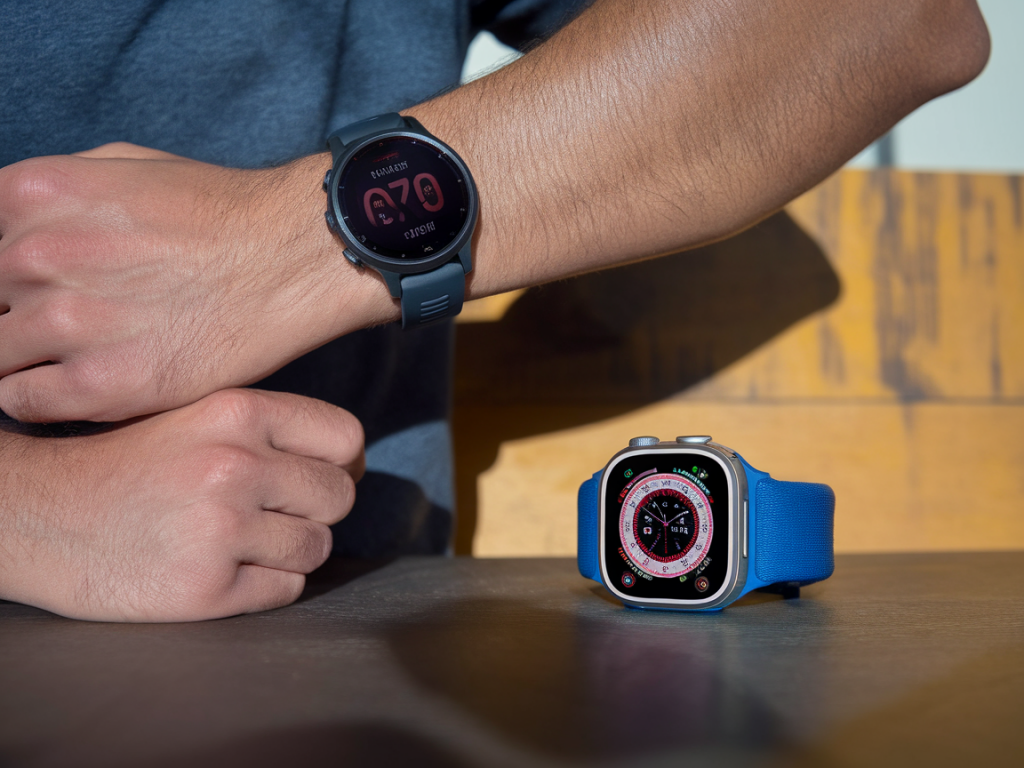
I’ve spent multiple multi-day trips wearing both a Garmin Epix and an Apple Watch Ultra, and I still get asked: which is the better choice for adventure tracking? There’s no single answer that fits everyone, but from the perspective of someone who cares about reliable maps, long battery life, and clean, reproducible data, the differences matter. Below I walk through the key areas that actually change the day-to-day experience on long outings — battery, navigation, sensors & accuracy, durability & controls, safety & communications, and the software ecosystems that make the data useful afterwards.
Battery life: the single biggest real-world difference
For multi-day navigation and tracking, battery life is the feature that most often decides whether your watch helps or becomes another thing to manage. In my experience the Garmin Epix consistently wins here.
The Epix (Garmin’s high-end multisport watch with AMOLED and multi-band GNSS options) is built around long-duration use. It offers multiple power modes, including battery-optimized GPS and “expedition” style modes that slash power draw to stretch tracking over several days. I’ve run multi-day hikes where precise breadcrumb tracking and periodic full GPS fixes continued for 48–72+ hours by leaning on these power profiles.
The Apple Watch Ultra is impressive for a smartwatch: excellent power management for a full-featured watch, but its full-GPS, high-frequency tracking will run down faster than a Garmin configured for endurance. Apple has improved low power modes in recent watchOS releases, and the Ultra is better than previous Apple Watches for all-day battery and longer training sessions — but it still prioritizes rich display and cellular features over marathon battery life. On long expeditions where I want continuous GPS logging, I’ve had to compromise on sampling frequency to hit 24–36 hours on Ultra; with Garmin I could maintain higher-frequency tracking much longer.
Navigation and mapping
Maps and route tools are where Garmin’s DNA really shows for outdoor folks.
What I find most useful on the Epix:
The Apple Watch Ultra has very competent maps for backcountry navigation — including a compass app with waypoints, waypoint navigation, and downloadable maps for offline use — and it’s approachable for users who prefer a phone-like interface. But compared to Garmin’s mapping stack, Ultra’s routing and map detail are less aimed at technical navigation. For example, if you want to follow contour-accurate routes, combine high-detail topographic maps with custom GPX and advanced map layers, Garmin’s toolchain (and third-party integrations like Komoot, Gaia, and ViewRanger) is deeper.
Sensors, tracking accuracy and performance metrics
Both watches pack excellent sensors: optical heart rate, barometric altimeter, accelerometers, compass and pulse-ox. Their raw sensor quality is comparable, but the software layer changes how useful that data is for long adventures.
Apple focuses on accurate daily health metrics with tight phone integration; if you want the watch to be your only device and you value simplified, reliable outputs, Ultra does a great job. For in-depth performance analytics tailored to endurance athletes, I prefer Garmin’s approach.
Durability, user interface, and controls
Practical factors that matter on long outings:
Safety and communications
This is where the ecosystem plays into life-or-death decisions.
If immediate SOS without carrying a separate satellite communicator is non-negotiable, Ultra’s integrated services are compelling. If you already carry an inReach or SPOT for two-way messaging and want a long-lived GPS tracker, Garmin integrates better into that setup.
Software ecosystem and data handling
After the trip is finished, the quality of your data and how you can use it matters just as much as it did on the trail.
Practical recommendation from the field
Speaking plainly: for long multi-day adventure tracking where the objective is to log every mile, follow topo-accurate routes, and avoid battery anxiety, I usually reach for the Garmin Epix. Its battery modes, mapping depth, and multi-band GNSS produce data I can trust across long expeditions.
But that doesn’t make the Apple Watch Ultra a bad choice. For trips where I value emergency satellite SOS without extra hardware, want a bright display and excellent smartwatch features, and expect to be within a day or two so battery can be managed, the Ultra is a compelling, more phone-like option. Many users will accept its shorter continuous-GPS runtime in exchange for cellular messaging and an easier UI.
| Feature | Garmin Epix | Apple Watch Ultra |
| Battery for continuous GPS | Superior — multiple power modes for multi-day tracking | Good — shorter when recording high-frequency GPS |
| Mapping & routing | Best-in-class topo maps, offline routable maps | Competent offline maps, simpler routing |
| Emergency comms | inReach integration (may need separate device/subscription) | Built-in cellular and Emergency SOS via satellite |
| Sensor & performance analytics | Advanced training metrics and export options | Strong health metrics, better phone ecosystem |
| Controls for harsh conditions | Physical buttons + touchscreen | Action button + touchscreen; touchscreen more sensitive |
If you want help choosing for a specific kind of trip — bikepacking vs. alpine winter traverse vs. a thru-hike — tell me the trip profile and I’ll give a tailored recommendation (including suggested GPS settings and map layers to use). I test these devices in the lab and on real trips, so I can share the exact power and navigation settings that made a difference on multi-day outings.