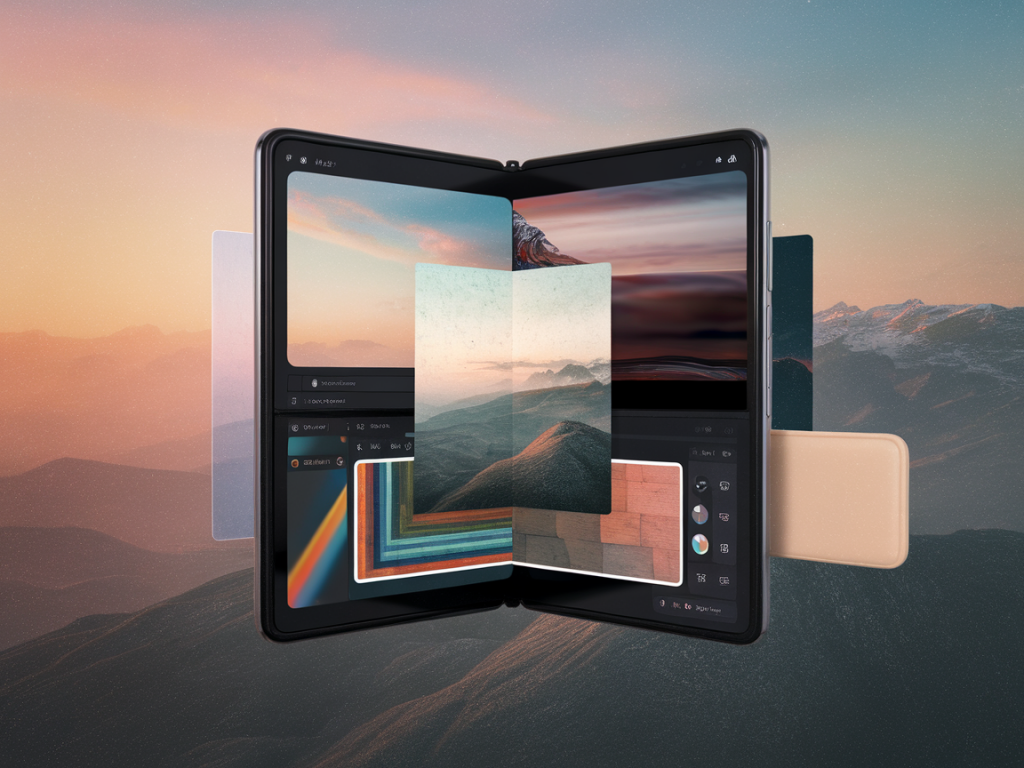
I’ve been carrying the Google Pixel Fold as a daily device for several weeks now, and one question keeps coming up in DMs and comments: can the Pixel Fold handle pro-level photo editing and layer-based workflows on the go? I pushed the Fold through realistic editing scenarios — heavy RAW edits, multi-layer composites, frequent app switching, and long export sessions — to see how it performs when you need more than quick phone fixes.
Why this matters
Modern photographers and creators increasingly expect to edit full projects away from a desktop. That means working with large RAW files, multiple adjustment layers, masks, selections, and exporting high-resolution deliverables. The Pixel Fold is one of the few foldables with a large internal display and flagship internals that promise desktop-like capabilities while remaining pocketable. But real-world performance is where it counts — not just specs.
Hardware and software setup I tested
Quick summary of the unit I used and the software I tested on it:
- Device: Google Pixel Fold (review unit, latest firmware at test time)
- SoC: Tensor G2
- RAM: 12GB
- Storage: 256GB UFS
- Displays: outer 5.8" and inner 7.6" foldable OLED
- Apps tested: Adobe Lightroom Mobile, Adobe Photoshop for Pixel Fold (beta/optimized), Snapseed, Affinity Photo (Android beta where applicable), and several small utilities for masks and layers
Workflow tests I ran
I designed tests to resemble what a freelance photographer or social media creative would do between shoots or on location:
- Edit full-frame RAW files (25–40MB) from a Sony A7 series — global and local adjustments, noise reduction, and lens corrections.
- Open a complex PSD with 15 layers (adjustment layers, masks, blending modes, and a few smart objects) and perform non-destructive edits.
- Create composites — extract subjects, place them on new backgrounds, apply color grading layers and texture overlays.
- Multitask: run Lightroom and Photoshop side-by-side on the unfolded display, with a reference image in a floating window.
- Export 20+ images to high-resolution JPEG and TIFF while checking thermal and battery impact.
Performance: raw editing and local adjustments
On straight RAW editing in Lightroom, the Pixel Fold is impressively responsive. Basic sliders (exposure, contrast, highlights, shadows) update in real time on the internal display. Texture and clarity tweaks are slightly more laggy than a flagship laptop GPU-assisted workflow, but still usable. Noise reduction at higher strengths takes a second or two to preview, which is reasonable on-device processing.
What matters to me is predictability: the Fold delivered consistent frame rates while panning and zooming around a 45MP RAW file. The 12GB of RAM helps; Lightroom rarely forced reloads during a single session. For travel edits or quick client previews, I’d confidently use the Fold for RAW corrections and grading.
Layer-based workflows and compositing
This is where the limitations are visible. Native Photoshop on Android (optimized versions) supports layers and masks, but handling a 15-layer PSD pushed the device. Simple layer operations — opacity changes, adjustment layers, clipping masks — worked fine. Complex tasks like smart object transforms, multiple large Gaussian blurs, or high-res displacement maps introduced noticeable lag. Undo/redo remained stable, though some filters required waiting for render passes.
Affinity Photo on Android was closer to desktop behavior for some operations, but it’s still in beta on many devices. I found myself adapting: do rough composites on the Fold, then finalize heavy effects on a desktop. That’s still a valid mobile-first workflow for many professionals — capture, rough-edit, send to client, finalize later.
Multitasking and UI ergonomics
The unfolded 7.6" canvas is a real advantage. I could run Lightroom on one side and Photoshop or a reference image on the other. The drag-and-drop between apps worked smoothly for moving images into compositing apps or sending photos to messaging apps for client review.
One ergonomic note: precise mask work is harder with finger input. I tested both finger and a generic capacitive stylus. The stylus helped but lacks pressure sensitivity and palm rejection of an Apple Pencil or Surface Slim Pen. If you depend on detailed brushing and pressure-sensitive strokes, the Pixel Fold isn’t a complete replacement for a tablet with active stylus support.
Battery and thermal behavior
Long export sessions and sustained layer operations warmed the device, mainly around the hinge and upper half of the inner display. Performance throttling did occur after extended heavy sessions (30+ minutes of continuous heavy rendering), leading to slower export times. Battery drain is noticeable when exporting TIFFs or long batches; plan for charging or split sessions when you need to finish a big job on the go.
File management and accessory support
Storage management is straightforward — the Files app and Lightroom integrate well for local storage and SD card imports via USB-C readers. I moved large shoots onto the Fold via a card reader and a portable SSD without hiccups. USB-C OTG support is reliable; you can tether drives and even use a small USB-C hub to attach Ethernet or a full-sized SD reader.
When the Pixel Fold is a great choice
- Quick professional edits and client previews when you need to be mobile.
- On-location culling and grading where portability beats raw power.
- Hybrid workflows: start and iterate on the Fold, finish on desktop when necessary.
- Sharing and collaboration — instant exports for messaging, social, or cloud sync.
When you’ll hit the limits
- Extensive layer-heavy compositing with complex filters and smart objects — desktop-class GPU horsepower still wins.
- Precision brushwork requiring pressure sensitivity and palm rejection — stylus support is limited compared with iPad or Surface.
- Large batch exports without access to power — battery and thermal throttling become factors.
Comparison snapshot
| Pixel Fold | iPad Pro (M2) | Surface Pro 9 (i7) | |
|---|---|---|---|
| RAW editing | Excellent, real-time for most tasks | Excellent, very responsive | Excellent, desktop-grade |
| Layer workflows | Good — starts to lag on complex PSDs | Very good — optimized apps and Pencil | Best — full Photoshop desktop experience |
| Stylus support | Basic capacitive only | Pro-level with Pencil | Pro-level with Surface Pen |
| Portability | Best — phone + tablet in one | Very good — tablet form | Less portable — laptop replacement |
Overall, the Pixel Fold is a genuinely useful tool for creators who need to be nimble. It doesn’t replace a desktop or a professional tablet with advanced stylus features for certain high-end tasks, but it does something those devices can’t: provide a fully capable, portable editing environment that fits in your pocket. If your workflow emphasizes mobility, quick turnarounds, and on-location edits, the Fold is worth considering. If your day-to-day requires heavy compositing, pressure-sensitive brushwork, or long batch renders without power, pair the Fold with a desktop for the heavy lifting.